


INTRODUCTION
3D printing has entered a phase where core mechanics matter more than novelty, with modern machines relying on stiffer kinematics, tighter belt paths, and more efficient thermal management to maintain dimensional accuracy across long prints. Improvements in auto‑calibration, nozzle pressure control, and closed‑loop motion have also reduced the variability that once made entry‑level printing unpredictable. As users progress, they often expand into larger build volumes, higher flow rates, or optional multi‑color systems that add complexity without altering the underlying extrusion physics. Within this landscape of increasingly mature hardware and modular capability, QIDI’s new Plus5 is positioned as part of this broader shift toward stable, scalable, and user‑configurable platforms.
Our story formed in 2014, QIDI Tech began with a small team of engineers with a big vision: we wanted to make 3D printing accessible to everyone. Crazy? A little bit. With our journey have consistently focused on more than just producing machinery; it's about enabling creators of all kinds to bring their ideas to life. Every day, we're doing more than just constructing printers. We are establishing an environment where seasoned designers and adventurous individuals can join forces, work together, realize ideas, and develop. QIDI Tech 3D printers are created to be intuitive and efficient, after all, delivering a hassle free printing process for all users from the beginning should be the top priority. Our extensive manufacturing plant and advanced research and development center embody our commitment to creativity, excellence, and teamwork.
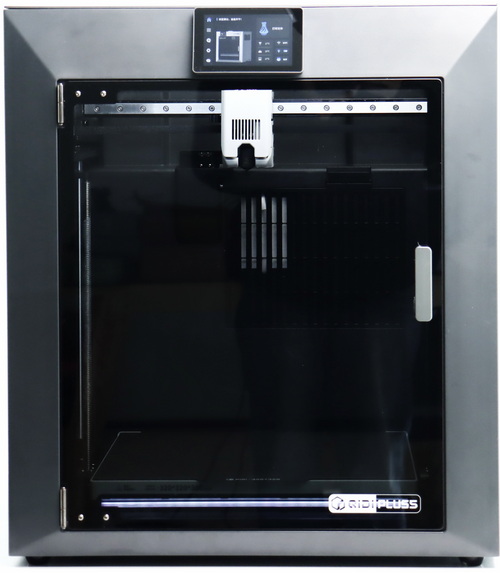
The Plus5 is built around a CoreXY motion system with a high‑hardness linear guide rail on the X‑axis and automatic belt tensioning, while the Z‑axis uses dual independent lead screw motors supported by 10mm linear shafts and screws for stable vertical movement. Its print volume reaches 320x320x300mm inside a 500x488x558mm chassis weighing 29kg. The print head pushes temperatures up to 370°C, driven by a direct extruder with hardened steel dual gears, a ceramic‑plate heated multi‑metal hot end, and a bimetal nozzle available in 0.4mm standard or 0.2/0.6/0.8mm options, all feeding 1.75mm filament. The bed system combines an aluminum‑silicone heating bed with a dual‑sided textured PEI plate and reaches up to 120°C. Performance is driven by a 600mm/s maximum toolhead speed and acceleration up to 20000mm/s, supported by a full suite of PWM‑controlled fans with RPM feedback for hot end, auxiliary, and part cooling, plus a closed‑loop motherboard fan and a second‑generation chamber heating fan capable of raising the enclosure to 65°C. Air quality is handled by a 3‑in‑1 filtration module combining a G3 pre‑filter, H12 HEPA, and activated carbon. The printer supports a wide range of materials (PLA, ABS, ASA, PETG, TPU, PA, PC, and carbon/glass‑fiber composites) and includes filament cutting, clog detection, tangle detection, run‑out sensing, and print recovery when paired with the QIDI BOX. A full sensor suite adds AI camera detection (640x480p default, 1920x1080p native), resonance compensation, automatic leveling via a loadcell integrated into the hot end, and power‑loss recovery. Power delivery spans 100–240 VAC with a combined rating of 150W for the main system, 550W for chamber heating, and 500W for the hot bed. The electronics include a 4‑inch 800x480p touch screen, 32GB EMMC storage, and USB 2.0 support, while connectivity covers Wi‑Fi 2.4GHz, Ethernet, and USB. Software compatibility extends beyond QIDI Slicer to Cura, PrusaSlicer, and others, with support for STL, OBJ, 3MF, and STEP formats across Windows, macOS, and Linux.