



INTRODUCTION
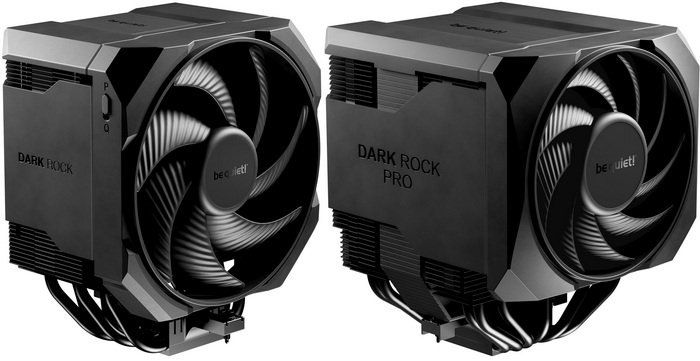
CPU air coolers remain the most reliable and maintenance‑free way to keep modern processors under control, especially as power limits continue to climb and boost algorithms push thermals harder than ever. A well‑designed tower cooler still offers an ideal balance of acoustic comfort, thermal consistency, and long‑term durability, without the pump noise, potential leaks, or lifespan concerns that sometimes accompany liquid AIOs. Within this space, high‑end dual‑tower and large single‑tower designs have become the go‑to choice for users running powerful CPUs or chasing near‑silent operation. These coolers rely on dense fin stacks, high‑pressure fans, and carefully engineered heatpipe layouts to deliver performance that rivals mid‑range AIOs while keeping noise levels impressively low. That’s exactly where be quiet!’s new Dark Rock 6 and Dark Rock Pro 6 enter the picture.
We are the German premium brand manufacturer of quiet hardware components for gaming, workstations and desktop PCs. Since our foundation in 2001, we are proud to have more than 20 years of experience in the industry. Our goal from the very beginning has been to develop products of the highest quality that are not only quiet, but also extremely powerful. With a wide range of power supplies, PC cases, water and air coolers and fans, we have established ourselves as a leading manufacturer in this field.
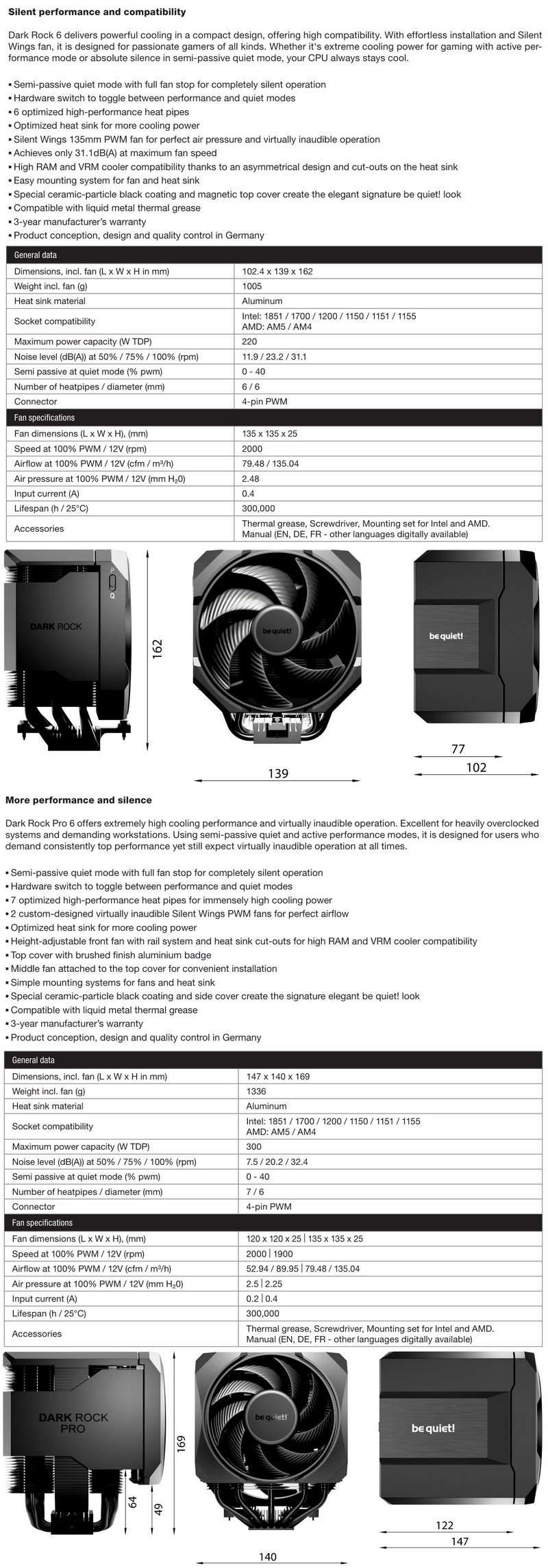
As successors to two of the most respected CPU air coolers on the market, the new Dark Rock 6 and Dark Rock Pro 6 aim to refine the formula with stronger thermal performance, updated fan technology, and the same signature stealth aesthetic. Both coolers follow be quiet!’s familiar formula of thick aluminum fin stacks, precision‑machined copper heatpipes, and tightly controlled fan acoustics, the scale however differs significantly between the two. The Dark Rock 6 features a TDP of 220W and uses six, 6mm thick copper heatpipes routed through a tall single‑tower fin array, with the fins spaced closely enough to favor static‑pressure‑optimized airflow. Cooling is handled by a 135mm Silent Wings PWM fan mounted on removable rails, making RAM clearance and installation easier. The fan tops out at 31.1dBA and features a Performance/Quiet switch, which adjusts the PWM curve. The Dark Rock Pro 6 on the other hand features a TDP of 300W and scales this up with seven 6mm thick heatpipes and a dual‑tower structure, giving it a much larger thermal mass and more surface area for sustained high‑load cooling. Airflow comes from a 135mm center fan and a 120mm front fan, both Silent Wings models with FDB bearings and high‑pressure blade geometry. Like the single‑tower model, the Dark Rock Pro 6 includes removable fan brackets and the same Performance/Quiet switch (located on the center fan module).
SPECIFICATIONS AND FEATURES
PACKAGING AND CONTENTS

be quiet! once again uses their all-black boxes the front of which (to be precise it's the top of the Dark Rock 6 box) is taken by a product picture, their logo and the model name.

The specifications table is on the right side (the Dark Rock 6 box also has two product pictures showcasing its main features).

A few words about be quiet! are printed on the left side.

At the rear of the Dark Rock Pro 6 box we find two product pictures used to showcase its main features while at the rear of the Dark Rock 6 box we just find its name and TDP (thermal design power).

Both coolers are placed between two thick pieces of cardboard.

Along with the Dark Rock 6 and Dark Rock Pro 6 be quiet! has bundled a Philips screwdriver, Thermal paste tube, backplate and all the pieces required to mount the coolers onto Intel LGA 1150/1151/1155/1200/1700/1851 and AMD AM4/AM5 motherboards.
THE DARK ROCK 6 & DARK ROCK PRO 6

When placed side by side it's easy to see that the 162mm tall, 139mm wide and 102mm long Dark Rock 6 is dwarfed by the 169mm tall, 140mm wide and 147mm long Dark Rock Pro 6.

Since both models feature removable fans, they have fixed rail Systems on the sides.

The top of the Dark Rock 6 is magnetically attached to the heatsink while the top of the Dark Rock Pro 6 has the center 135mm attached to it.

Needless to say, the front fans are also removable (and height adjustable).


Both the front fan of the Dark Rock 6 and the center fan of the Dark Rock Pro 6 feature a performance/quiet switch (the front 120mm fan of the Dark Rock Pro 6 connects to the center one).

It may not be very easy to distinguish from the above picture but the Dark Rock Pro 6 comes with a total of 51 aluminum fins while the Dark Rock Pro 6 a total of 90 (45x2).
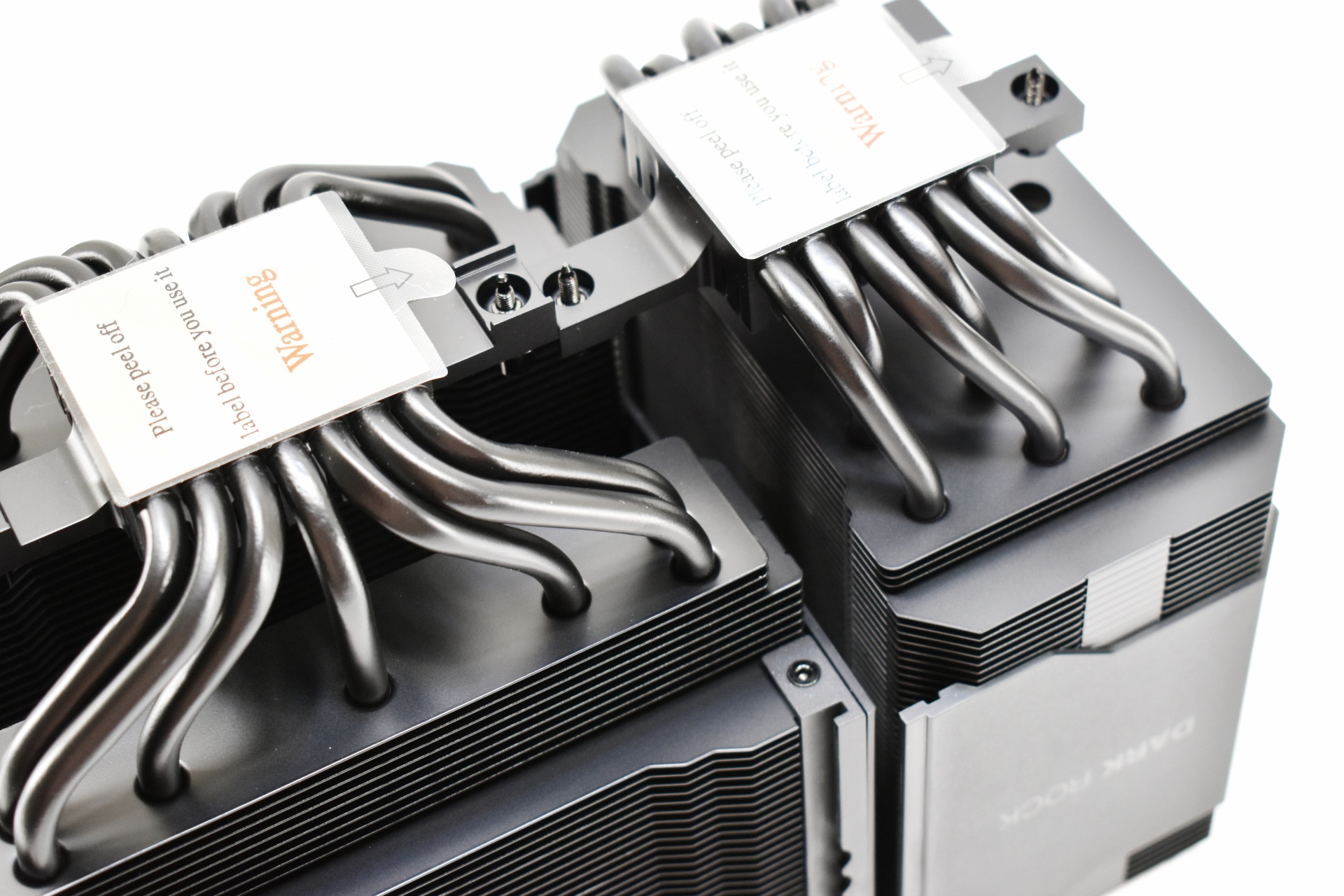
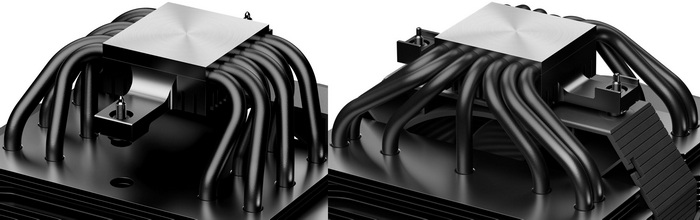
Both coolers feature 6mm thick all-copper heatpipes, difference is that the Dark Rock Pro 6 has one more.

When it comes to base both the Dark Rock 6 and Dark Rock Pro 6 have all-copper nickel-plated ones.
INSTALLATION
Mounting the new CPU air coolers by be quiet! is very easy, first you will need to use the backplate (for Intel systems).

Next you will need to attach the spacers onto the backplate (almost the same if you use an AMD system with the stock backplate).
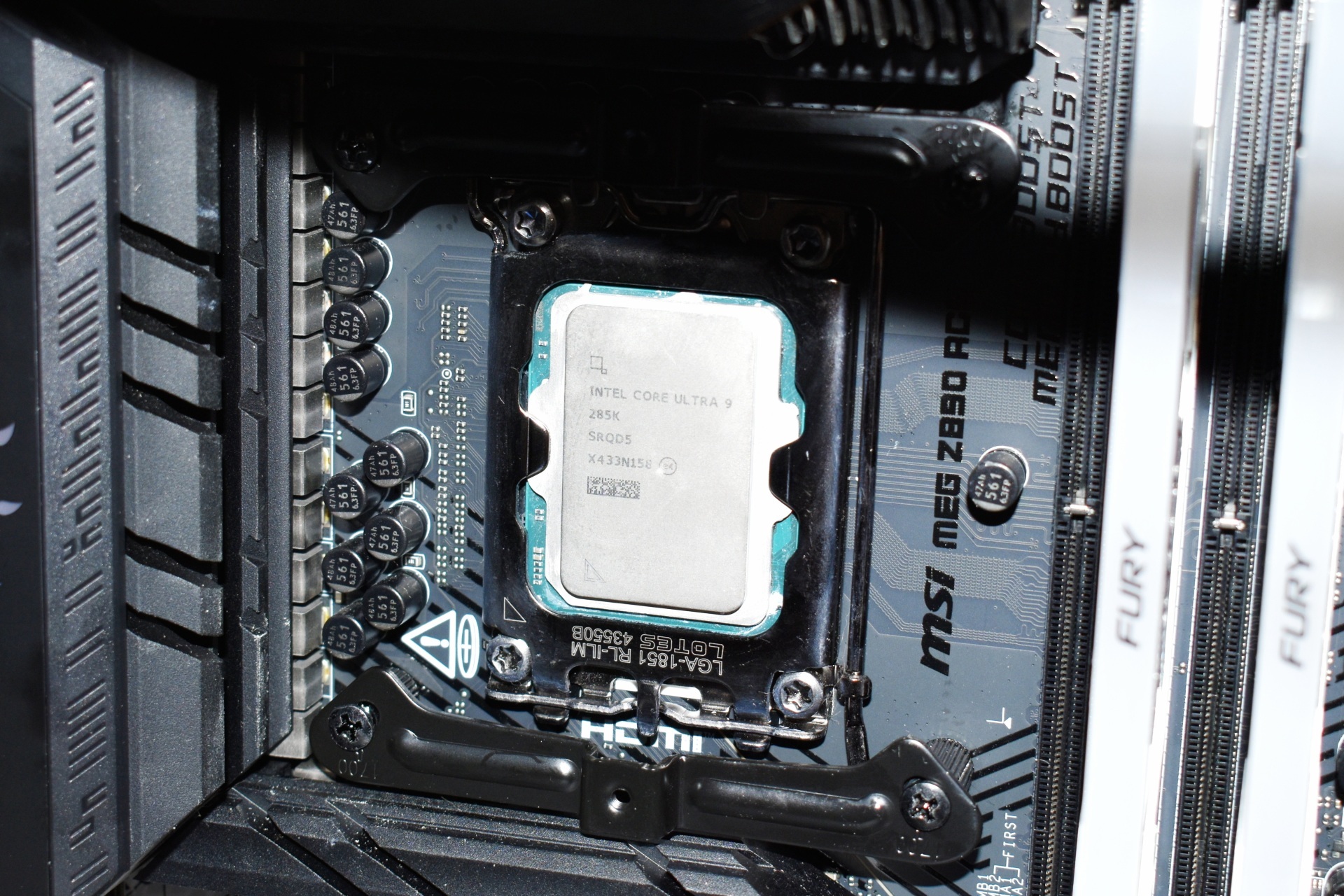
The brackets come next and here things change a bit since for the Dark Rock Pro 6 you will need to mount them up and down whereas for the Dark Rock 6 you will need to mount them left and right.
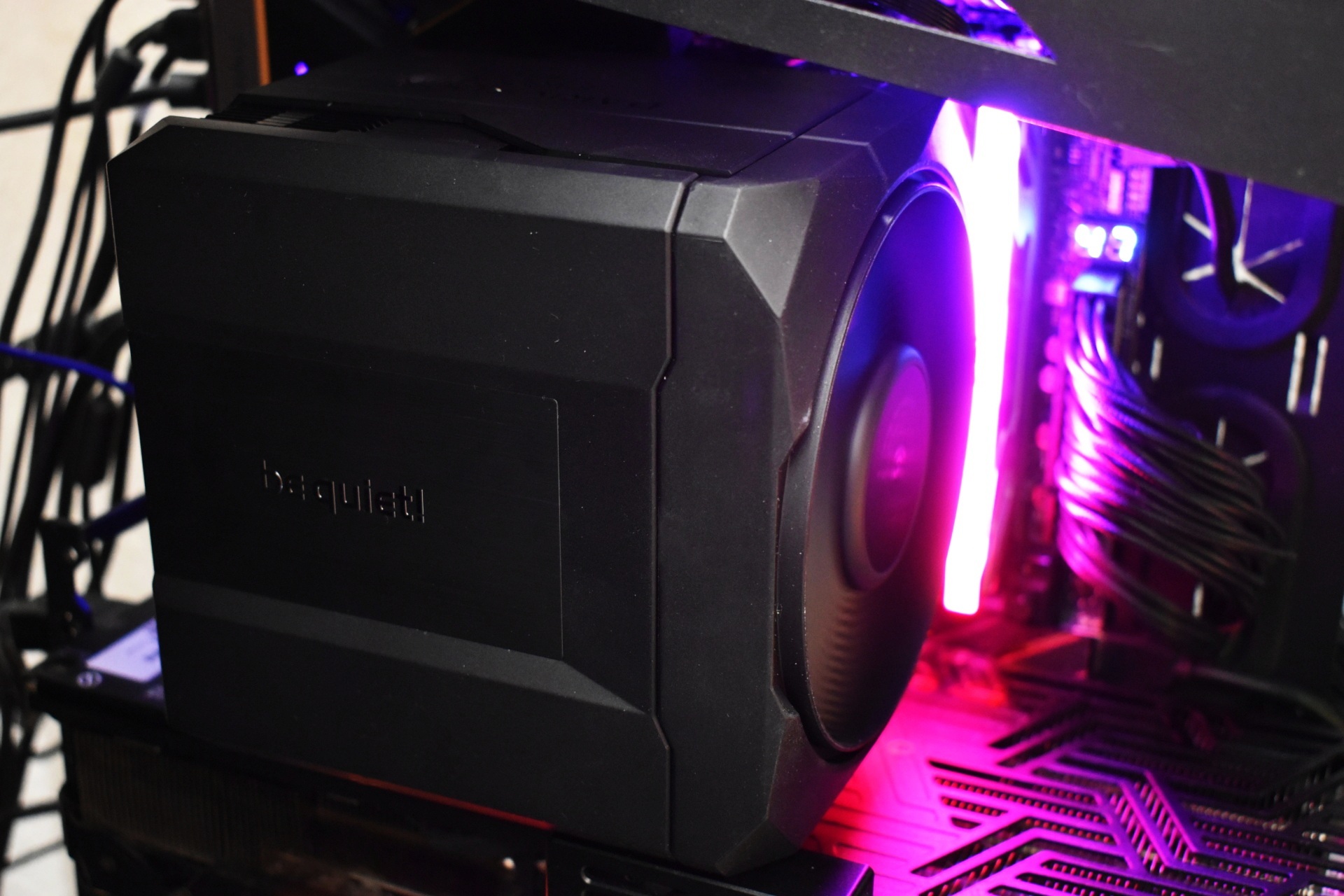

Here you can see the difference in size between both coolers (and that the Dark Rock Pro 6 is almost as large as the NH-D15 G2 cooler by Noctua).
TEST BED
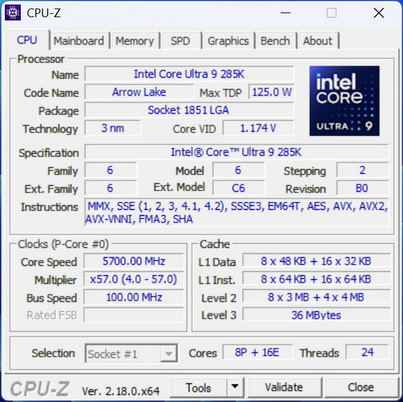

TESTING METHODOLOGY
I always take things quite seriously when it comes to work so just like with the previous LGA1366 and LGA2011 databases every single CPU Cooler in the charts will be tested under the same exact conditions. Testing a CPU Cooler automatically means that you need to know where it stands against the immediate competition and to accomplish that I’ve spent both money and time through the years, something that I honestly plan to continue to do so in order to get the most accurate results for the end consumers who read these lines. Every CPU cooler in this database is tested with the bundled 140mm/120mm/92mm/80mm fans while working at both idle speed and 100% of their speeds for all the temperature tests. CPU Coolers that do not come bundled with a fan/s are measured using a Noctua fan (size dependent on the model) to test for the temperature tests but due to the lack of a stock fan dBA level tests are obviously skipped. Single (120/140mm) watercooling solutions are tested with the radiator mounted at the rear of our test rig while dual/triple/quad (240/260/280/360/420/480/560mm) solutions with the radiator mounted at the top. For the dBA tests every cooler in the database was measured both while on idle mode or with the fan controller in the minimum setting and while on extreme load or with the fan controller all the way to the highest possible setting (PWM fans do that on their own without our intervention). Every single test takes place in a temperature controlled room of 23 degrees Celsius Ambient Temp with the help of two AC units placed diagonally inside the room. The Noctua NT-H2 thermal paste is used with every CPU Cooler. Finally, it's very important to point out that just because a CPU Cooler is better than another when tested with a specific system that does not necessarily mean that the same performance differences will apply 100% for other CPU models and in other situations (such as different ambient temps and system configurations).
To successfully record the load temperatures, we use the latest OCCT application for around 6-10 minutes to push the processor to its limits and after that is done and the temperatures are recorded, we wait for about 10-20 minutes for the CPU to cool down and record the idle temperatures. This is done to allow time for the thermal conductive material to achieve the optimal performance level. Same procedure is then repeated with the Passmark BurnIn Test as a failsafe just in case the OCCT results are wrong. This procedure is more time consuming than the usual peltier/thermometer tests but this way not only can readers get results based on real CPUs but those results can also be triple checked by using a variety of programs. Last but not least the temperatures were recorded using the latest versions of AIDA64, HWiNFO and HWMonitor while the noise level tests are performed using a high precision ExTech HD600 Decibel Meter placed about 10-15cm above the CPU Cooler. Still although the same testing procedure applies to all units do take into consideration that unlike the official numbers which are measured in special noise isolated labs with just the fans here, we also have both the rest of the cooler and the rest of the system (although all system fans are turned off when recording noise levels).
* As of November 2024, the Core Ultra 9 285K is used for CPU cooler tests.
TEST RESULTS
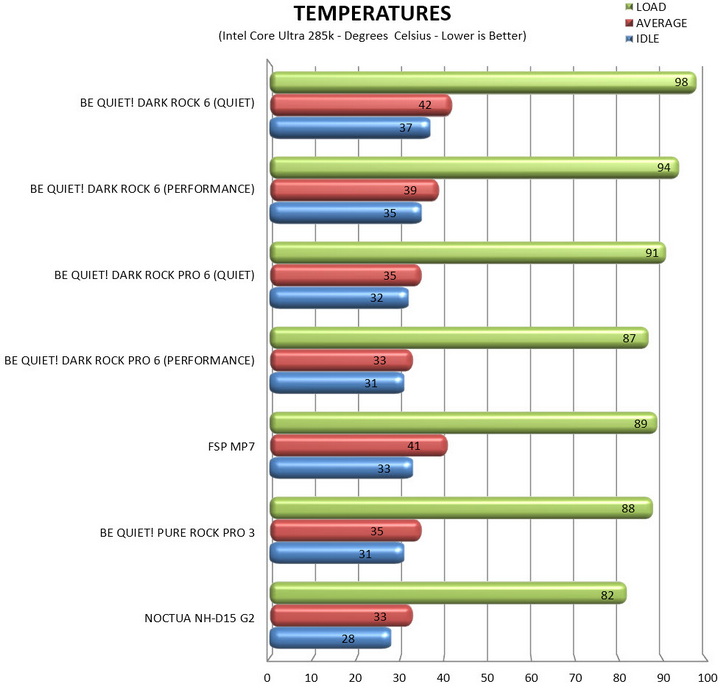
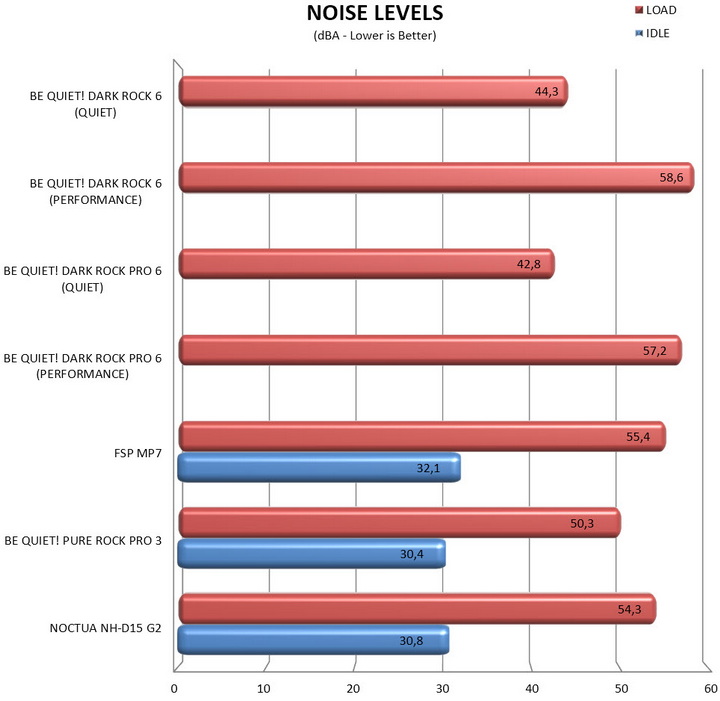
CONCLUSION
Both the Dark Rock 6 and Dark Rock Pro 6 reinforce why be quiet! remains one of the most consistent names in high‑end air cooling. Their strong thermal performance, excellent build quality, and the addition of the Performance/Quiet switch make them easy to tune for either silent operation or sustained boost workloads. The removable fan brackets and the fully black, stealth‑matte finish also give them a clean, premium look that many builders will prefer over flashier designs. That said, the Dark Rock Pro 6’s sheer size will limit compatibility in tighter cases, and both coolers can get quite audible when pushed in Performance mode. And while the all‑black aesthetic is a plus for some, the lack of RGB lighting may be a deal‑breaker for users building around a more expressive or color‑coordinated setup. Still, if your priority is reliable, efficient, and quietly capable air cooling, both models deliver exactly what they promise.
At the time of my review the Dark Rock 6 & Dark Rock Pro 6 CPU coolers by be quiet! retail for 81.63Euros/97.56Euros inside the EU (Amazon.de) and so they aren’t for everyone. Overall, both the Dark Rock 6 and Dark Rock Pro 6 CPU coolers by be quiet! may not be perfect but they do deliver as advertised and for that they deserve the Golden Award.

PROS
- Build Quality
- Stealth Design (Black Coating)
- Excellent Cooling Efficiency
- Fan Speed Switch (Quiet / Performance)
- Dual Fan Solution (Dark Rock Pro 6)
- Adjustable Height Front Fan
- Noise Levels (Quiet Mode)
CONS
- Price (For Some)
- Size (Dark Rock Pro 6)
- Lack Of RGB Lighting (For Some)
- Current Availability (USA)